
4.1 Complex Number
4.1.1 Definition
Any number of the form  is called a complex number, where
  and
and  are real numbers and
  is the imaginary unit.
The real part of the complex number,  , is
, is  , and
, and  is the imaginary part of .
4.1.2 Arithmetic Operations
Addition
(1) 
Subtraction
(2) 
Multiplication
(3) 
Division
(4) 
4.1.3 Conjugate
If  is a complex number, then the complex conjugate, or simply the conjugate, of is
(5) 
The arithmetic operations of a conjugate are as follows
(6) 
4.1.4 Modulus or Absolute Value
The absolute value of is defined as
(7) 
4.1.5 Geometric Interpretation
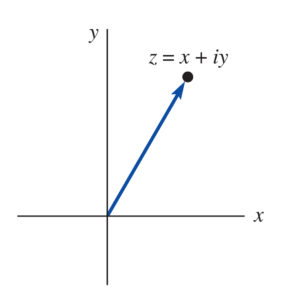
The following coordinate plane is known as the complex plane or simply the z-plane. The -axis is the real axis, and the -axis is the imaginary axis. The absolute value of a complex number is the distance of that number to the origin.
4.2 Powers and Roots
4.2.1 Polar Form
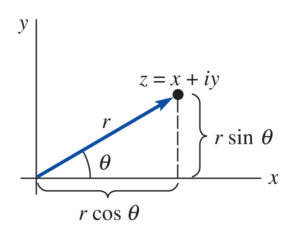
The polar form of a complex number,  , is
, is
(8) 
4.2.2 DeMoivre’s Formula
(9) 
4.2.3 Integers Powers of
The integer powers of a complex number can be found easily by applying the DeMoivre’s formula on the polar form of as follows
(10) 
(11) 
(12) 
4.2.4 Roots of
A number  is the
  root of a complex number , if
  .
.
Let’s assume that  , then we can find the values of
  and
and  as follows
(13) 
(14) 
So,
 , and
, and (15) 
By summarizing the results, the
roots of a given non-zero complex number are (16) ![\begin{equation*}w_k = r^{\frac{1}{n}} \left[ \cos \left( \frac{\theta + 2 k \pi}{n} \right) + i \sin \left( \frac{\theta + 2 k \pi}{n} \right) \right] .\end{equation*}](https://www.mohsenhamedi.com/wp-content/ql-cache/quicklatex.com-96bd4311b6f49a11d49fa8f0c42323ab_l3.png "Rendered by QuickLaTeX.com")
4.3 Problems
Reference
Dennis G. Zill. Advanced Engineering Mathematics,  edition. Jones
  Bartlett Learning. 2016.