
Notation and Terminology
In a  vector,
  is the start point and
  is the endpoint. And, the magnitude of such a vector is
  . Equal vectors have the same direction and magnitude.
The negative of a vector,  , has the same magnitude, but in the opposite direction of .
Addition and Subtraction
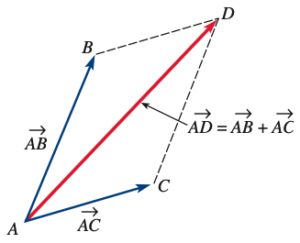
To add vectors in a coordinate plane, we have:
(1) 
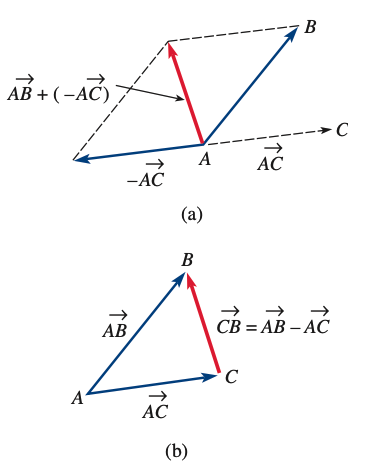
And the subtraction of two vectors is
(2) 
This is equivalent to
(3) 
which is depicted in figure a.
Magnitude of a Vector
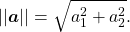
The magnitude, length, or norm of a vector is
(4) 
A unit vector, is a vector that has a magnitude of
 .
.
Normalization of a Vector
The normalized vector of  is a unit vector in the same direction as . This means that a non-zero vector is normalized as follows
(5) 
where
 is the normalized vector of .
The Unit Vectors in 2 Dimensions
The unit vectors  and
and  are known as the
  and
and  vectors, respectively.
In  space,
  and
and  are the horizontal and vertical components of , respectively.
The Unit Vectors in 3 Dimensions
The unit vectors  , and
, and  are known as the
  , and
, and  vectors, respectively.
The Distance Between Two Points
The distance between  and
and  in 3-space is
(6) 
Midpoint Formula
The midpoint of line segment between points  and
and  is
is
(7) 
Vectors in 3-Space
Similar to space, vectors are defined in  space as
  .
.
Reference
Dennis G. Zill. Advanced Engineering Mathematics,  edition. Jones
  Bartlett Learning. 2016.